April Fools’ Day in France & French Laughter Vocabulary 🤣
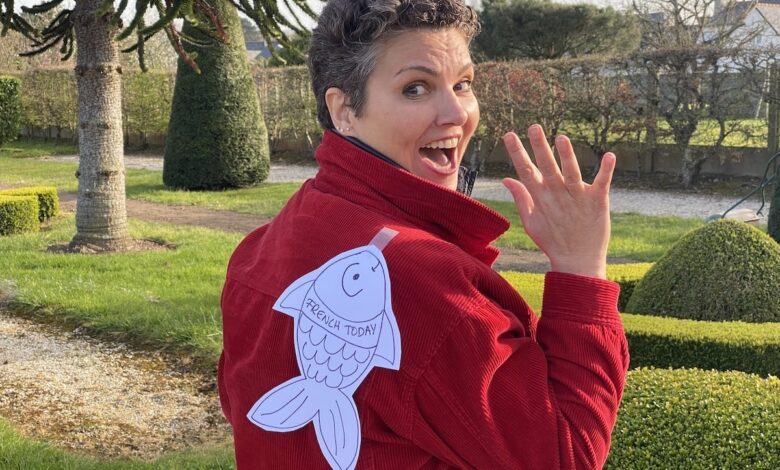
When we make an April fools’ prank in France we say « Poisson d’avril ». Learn the French vocabulary for fun & laughter & traditions for April Fools’ day in France.
Yes, April Fools’ day is a French tradition. But the name is quite different. There’s nothing to do with April or Fools, but the French star of the show is… a fish ! 🐟
How do you say April Fool’s Day in French?
We call April Fools’ day by the French date: April 1st. So in French, April Fools’ is “le premier avril”. There’s a strong liaison between the R and the A, therefore it sounds like “première” in the feminine, but it’s actually spelled in the masculine “premier”.
How do we celebrate April Fools’ in France?
The typical French April Fools’ prank consist of discreetly attaching a paper fish to the back of your unknowing victim… But all kinds of pranks are possible on “le premier avril”, especially fake news.
When the prank is revealed, we shout: “poisson d’avril”!!!
Where this habit comes from is not certain. There are several theories (read more here), but why the symbolic of the fish remains pretty much a mystery.
My April Fool’s Day in France Video
I shot a video in French to tell you about April Fool’s day in France!
This video comes with verified French and English subtitles – the CC option is located to the bottom right of the video: press CC to turn the subtitles on and off, and wheel to select French or English subtitles.
15 French Laughter Words
For a taste of French jokes, follow this link to 36 French jokes with audio recordings and English translations on French Today.
How to Say a Joke in French?
The most common way to translate a joke in French is “une blague”. It can be used for a prank or practical joke or a verbal joke.
How To Say “To Joke” In French?
The verb is important because it will set the context of the joke:
- if you use “faire”, then it’s an action and it’s likely you’re talking about a prank
Faire une farce, faire une blague, faire une plaisanterie : to make a prank
Yet we say “faire un jeu de mot”: to make a pun… - if you use “dire” or “raconter”, then it’s verbal.
Dire une blague, dire une histoire drôle: to tell/crack a joke
Watch out for “raconter des histoires” which could be an idiom meaning to lie, making up stories.
Arrête de raconter des histoires et dis-moi la vérité! Stop making up nonsense and tell me the truth!
We also have a series of specific verbs to say to joke, kid around:
- Blaguer : to joke
Mais non !! Je blague
No! I’m pulling your leg/ I’m kidding - Plaisanter : to joke
Ce n’est pas méchant : il plaisante, c’est tout !
It’s not mean, he’s only kidding. - Raconter des histoires: to tell things that are not true, to pull someone’s leg
Je ne te crois pas : tu me racontes des histoires !
I don’t believe you, you must be pulling my leg. - Faire marche quelqu’un : to take someone for a ride
Mais non, bien sûr que ce n’est pas vrai ! Je te fais marcher, et tu cours !!
Of course it’s not true: I’m taking you for a ride and you’re going a 100 miles… (I’m being a bit inventive with the translation here but you get the idea…)
French Words for Pranks, Tricks, Practical Jokes, Hoax
We have a series of French words for tricks, pranks and practical Jokes
- Une farce : a practical joke, a prank, a trick
Je vais lui faire une farce
I’m going to play to trick on him - Une blague : a joke (physical or verbal)
J’adore faire des blagues:
love doing pranks. - Un tour: a trick
Il a plus d’un tour dans son sac.
He has more than one trick up his sleeves - Un canular: a hoax
Regarde ! Il y a un canular à la télé : c’est un type avec une caméra cachée.
Look! There’s a hoax on TV: it’s a guy with a hidden camera.
9 French Words for Verbal Jokes
For verbal jokes, the French vocabulary we use differs a bit:
- Une plaisanterie : a joke (verbal, a bit old-fashioned)
- Une histoire drôle : a joke, a funny story (only verbal)
- Un jeu de mot : a pun – here are 10 French puns with audio explained.
- Une devinette : a guessing game
- Une blague : a joke
- Une blague grivoise : a dirty joke
- Une blague douteuse : a bad joke (could also mean a borderline dirty joke or poor taste)
- Une blague pourrie : a very bad joke (colloquial)
- Une farce : mostly used for physical jokes, but sometimes also used for verbal jokes.
Note the expression “sans blague !” which means “no way… no kidding!”
Tu as gagné au loto ? Sans blague!
You won the lottery? No kidding!
Please consider supporting our free French lesson creation: we’re a tiny 2-person company in France.
Support us on Patreon or by purchasing our unique audiobooks to learn French. Instant download. Learn French offline, at home or on the go on any device!
À Moi Paris Audiobook Method
A new approach to learning both traditional and modern French logically structured for English speakers.
12 Ways of Saying Funny & Fun in French
To say funny in French, we use several adjectives: I list them from the most common to the least common.
- amusant – the most common way of saying funny and fun in French
- drôle – very used but could also mean a bit strange.
- marrant – colloquial slang
- rigolo – colloquial slang
A bit let used… - divertissant – amusing
- distrayant – distracting
- désopilant – very funny
- hilarant – hilarious
- roulant – colloquial slang
- poilant – colloquial slang
Much less used… - fendant – colloquial slang
- cocasse (very formal) – funny and a bit strange
12 Ways to Say Laugh in French
- Rire : to laugh
- Le rire : laugher
- Rigoler : to laugh (colloquial)
- La rigolade : laughter (colloquial)
- Un fou rire : when you cannot stop laughing
- Hurler de rire : to laugh really hard and loud (!! nothing to do with ‘to hurl’)
- Éclater de rire : to burst in laughter, to start laughing really hard
- Pleurer de rire : to cry from laughter
- Se taper une barre (de rire)/des barres de rire : to laugh till it hurts (a new expressions used by the younger crowd nowadays)
- Je suis mort(e) de rire : MDR = I died laughing
- Je suis pété(e) de rire : broken in two from laughter = PTDR
- MDR, PTDR = LOL
Smile in French
- Sourire : to smile
- Le sourire : smile
- Être souriant(e) – to be smiling
- Sourire de toutes ses dents – idiom. To smile with all your teeth = have a big smile on.
April Fools’ French Joke 2017
Grown ups like to make jokes as well, announce fake info for April fools’ in France : it’s very common that play on words are also made by the media, radio, TV etc…
See what the RATP (the company managing the Paris Subway) did in 2017: they made puns with Paris métro station names! They glued some stickers around the names on the stations themselves.
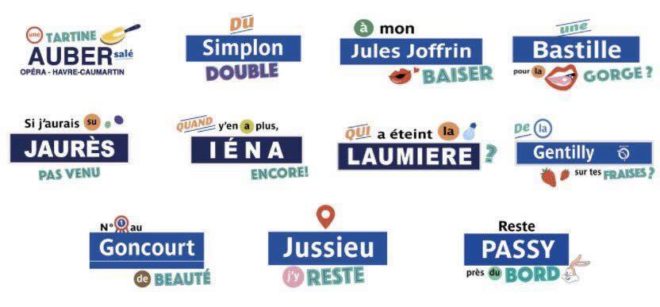
I’ll translate and explain them for you: all these are French puns, so the name of the station sounds more or like another French word and together makes a fun sentence.
- Auber = Tartine au beurre salé = toast with salted butter
- Simplon = du simple au double = an expression meaning the cost for example was doubled “from simple to double”
- Jules Joffrin = À mon Jules, j’offre un baiser = to my boyfriend, I give a kiss
- Bastille = Une pastille pour la gorge ? = a lozenge for the throat?
- Jaurès = Si j’aurais su j’aurais pas venu = famous quote from the movie “La Guerre des Boutons” and a mistake French kids would frequently make with French hypothesis using “si”/ if. It should be “si j’avais su je ne serais pas venu” – If I had known I wouldn’t have come.(
- Iéna = quand (il n’) y en a plus, il y en a encore = when there is no more there is some left – a famous French saying
- Laumiere = qui a éteint la lumière = who turned off the light?
- Gentilly = de la chantilly sur tes fraises = some whipped cream on your strawberries?
- Goncourt = numéro un au concourt de beauté = Beauty contest first prize
- Jussieu = J’y suis, j’y reste = I’m there and I’m staying
- Passy = (ne) reste pas si près du bord = don’t stay so close to the edge
Why are some words omitted such as the “il n’” or the “ne” – that’s modern French!

Unique Audio-Based
Modern French Level Test
20 Questions to REALLY test your modern French comprehension. All audio-based with full explanations. Completely free, no signup required
Here is My 2014’s French April Fools’ Joke
I sent this in my newsletter in 2014.
BREAKING NEWS! President François Hollande is to change his last name. “I’ve had enough of the confusion created by my last name” said France’s president to a TF1 reporter. The president has not yet disclosed his chosen last name, but rumor has it that he may choose “de France”, since “de Gaulle” has already been used…
Brought to comment on this exceptional measure, Marie Le Pen cried out “Poisson d’avril !!!”
Here is My 2012’s French April Fools’ Joke
Yesterday, President Nicolas Sarkozy announced an ambitious plan for mitigating the social health deficit: to sell the Parisian monuments, which presently belong to the city of Paris.
Many foreign powers have already made offers totalling several billion Euros. It seems that China is willing to pay 3 billion Euros for the Eiffel Tower alone.
The other monuments concerned are the Arc de Triomphe, the Petit Palais, the Sorbonne, the Paris Bourse, the Invalides, Grand Palais … and the bridges of the Seine.
The President said that Notre Dame cathedral as well as the Basilica of the Sacred Heart would be excluded from the negotiations because of their religious character.
“It is out of the question to move these monuments symbolic of the city of Paris, only to cede their title and their visa operation to make a profit that could solve the French economic crisis. “
Brought to comment on this exceptional measure, Carla Bruni cried out “Long live the April fools’. “
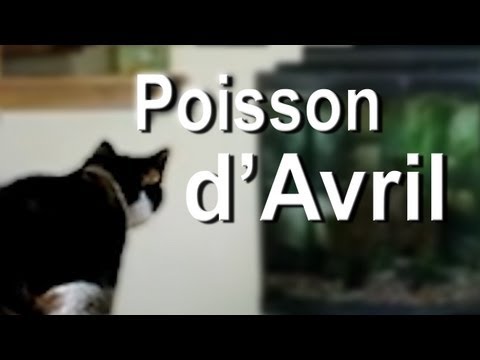
Here is an hilarious “poisson d’avril” video of a fish pranking a cat ! And it comes with English subtitles 🙂 Note the song at the end which is a very famous children song.
French April Fools’ Video
I often post new articles, so make sure you subscribe to the French Today newsletter – or follow me on Facebook, Instagram, Threads and Pinterest.
Please react! Leave a comment, make a suggestion, share this article… Your engagement really encourages me to create more free French lessons!